

Curatorial Note
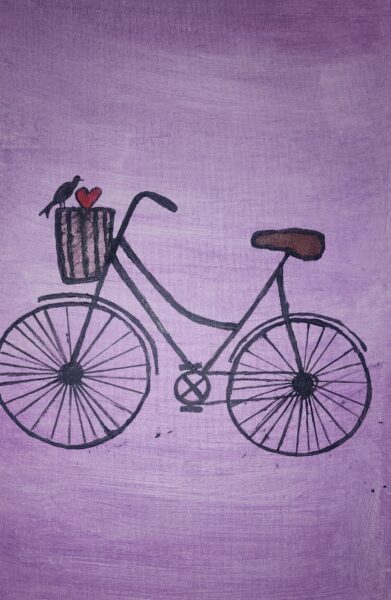
The eye is immediately drawn to the striking interplay of simplicity and boldness in Chenge Gonzo’s “Bicycle on Purple Background.” The foreground is dominated by the meticulous rendering of a lone bicycle, its silhouette both arresting and delicate, poised as though frozen mid-motion. The intricate detail of the bicycle’s structure—its thin spokes, rounded handlebars, and angular frame—belies its apparent stillness, suggesting it holds the energy of untold journeys. Surrounding this iconic object is a sea of textured purples, shifting subtly in hue from deep aubergine to soft lavender. Gonzo’s use of acrylics heightens the sensory experience: the background hums with rich layers of pigment, applied in varying densities, while the crisp lines of the bicycle evoke a sense of clarity and immediacy. There is a quiet drama embedded in this composition, a tension between motion and suspension, vibrancy and calm.
Chenge Gonzo’s practice is rooted in exploring everyday objects as vessels of memory, identity, and migration. Hailing from an urban Zimbabwean landscape, she confronts the way ordinary tools and vehicles become imbued with complex personal and communal histories. The bicycle, with its universal but deeply personal connotations, emerges in this work as a metaphor for movement and independence. Gonzo situates it against the purple background—a color associated with transformation and imagination—to reframe the familiar and celebrate a quiet ascension. Her body of work often engages themes of cultural mobility, reflecting her own experiences and those of her community, making “Bicycle on Purple Background” not merely a painting of an object, but a symbolic narrative of resilience and human connection.
In a global art world increasingly charged with questions of diasporic identity and ecological shifts, Gonzo’s work offers a poignant lens into how simple objects preserve histories and project futures. “Bicycle on Purple Background” resonates with audiences seeking clarity amidst complexity, reminding us of the importance of reexamining the everyday. At a time when movement—both physical and metaphorical—is restricted, celebrated, or precariously mediated, Gonzo’s painting asserts the bicycle as a timeless symbol of autonomy and possibility. Her deft use of color and form transforms this ordinary mode of transport into a profound visual language, adding an essential voice to conversations about contemporary African art’s ability to bridge introspection and collective experience.
Simunye Art Curation Team

Reviews
There are no reviews yet.